

Design of control and monitoring systems

Design of automation and central control system

Choosing a hardware architecture (PLC, DCS or BAS)

This service involves determining the most appropriate control architecture based on the scale and complexity of the project. For small to medium projects, industrial PLCs are used, and for larger projects, BAS or DCS systems are used. Selection criteria include reliability, scalability, ease of programming, and life cycle cost.

Design of control panels and input/output systems

In this service, documentation drawings and control panels are designed, including the placement of modules, fuses, relays, terminals, and power supplies. The number and type of input/output points (digital, analog, special) are determined based on the list of control points and an appropriate safety margin (15 to 20 percent) is considered.

Definition of control points and control logic (PID, ON/OFF)

This service includes identifying all controllable variables (temperature, pressure, humidity, engine speed, valve position) and developing control logic appropriate to each. For continuous processes, PID controllers with optimal coefficients are used, and for discrete processes, ON/OFF logic and timers are used. All logics are documented in the form of flowcharts and truth tables.

Monitoring and SCADA system design:

Sensor and instrumentation network design
This service includes determining the type, measurement range, accuracy and installation location of temperature, humidity, pressure, flow, gas, smoke and power consumption sensors. Sensors are selected based on environmental conditions (e.g. high humidity, variable temperatures) and their initial and periodic calibration is foreseen in the technical specifications. Cabling routes and type of protection (e.g. anti-interference) are also designed.
Development of graphical monitoring screens
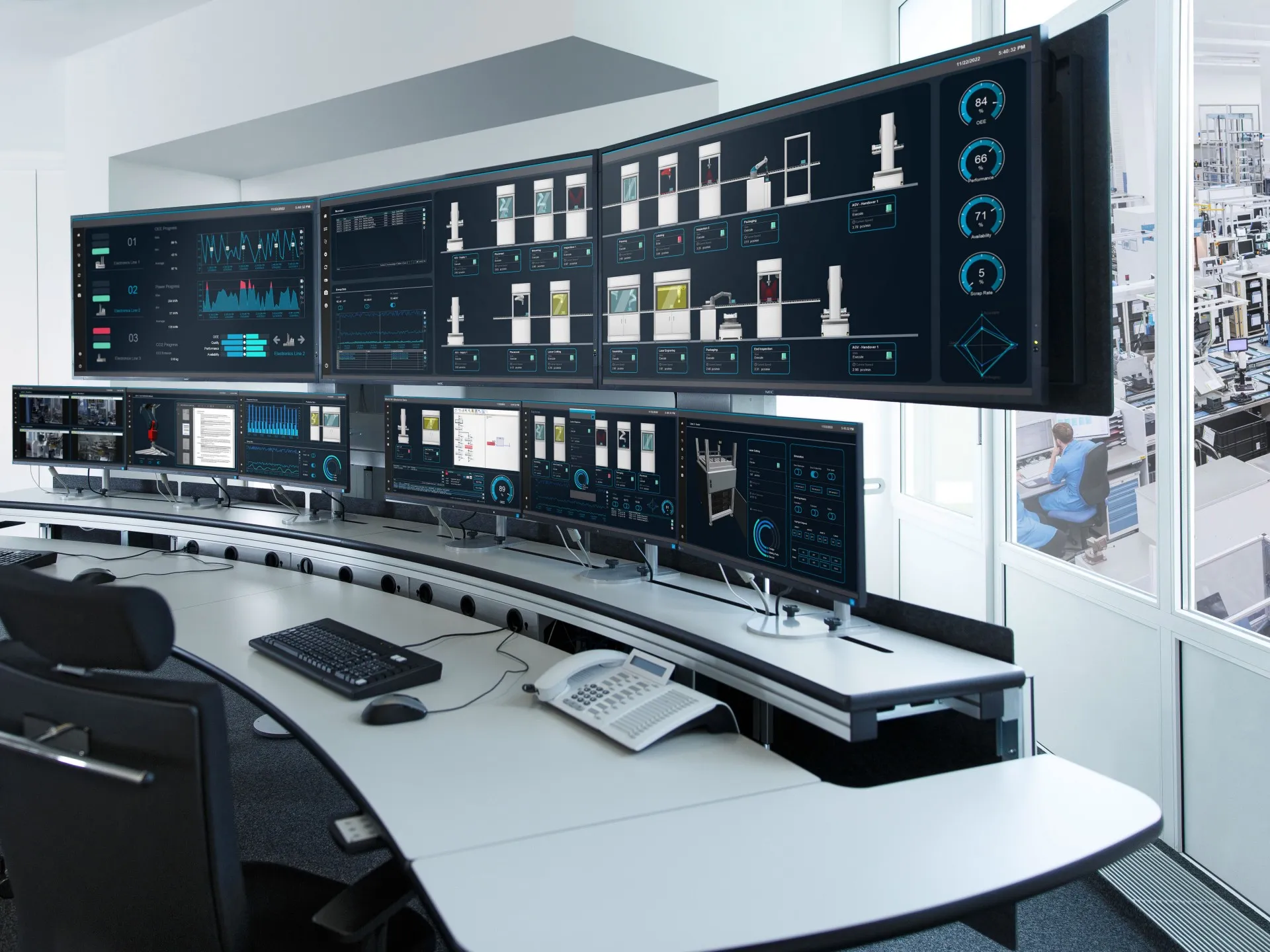
In this service, user-oriented graphic pages are designed to display equipment status, variable trends, facility maps, and alarms.
Design of alarm and event recording system
This service includes defining different alert levels (warning, warning, critical), thresholds, delay times and automatic actions (such as stopping the equipment, activating the ventilation). All events (starting/stopping the equipment, changing the status, alarms, user logins) are recorded in the database with time and user ID. It is possible to search, filter and export reports.

Energy management system design and integration

Design of energy consumption monitoring subsystem
In this service, all energy consuming equipment (motors, compressors, chillers, air conditioners, lighting systems) are equipped with smart electricity, gas and water meters. Consumption data is collected in real time and hourly, daily and monthly consumption graphs are calculated along with a consumption index per unit of production (e.g. kilowatt-hours per meal). The capabilities of this subsystem include detecting abnormal consumption and providing corrective suggestions.
Integration with HVAC, lighting and fire suppression systems
This service includes establishing two-way communication between the central control system and other facility subsystems. The air conditioning system is adjusted based on CO2 levels and personnel presence. Lighting is controlled based on natural light and human movement. In the event of a fire, the central control system stops all ventilation fans and shuts off gas valves upon receiving an alarm from the fire extinguishing system. Standard communication protocols (such as BACnet, Modbus, LonWorks) are used.
Designing a communication interface with a building management system (BMS)
In this service, a shared gateway and database are designed to exchange information with the building's BMS. Parameters such as temperature of different points, alarm status, and energy consumption are sent to the BMS center and control commands are received from the BMS if necessary. Cybersecurity considerations including authentication, encryption, and firewall are carefully designed at this layer.

final output

Delivery of a complete set of command documentation drawings, sensor network schematics, control point list (I/O List), SCADA page design, control and monitoring equipment technical specifications, control logic manual, and integration protocols.