





Industrial kitchens are the operational heart of many food businesses, and their productivity has a direct impact on reducing costs, improving quality, and enhancing customer satisfaction. Increasing productivity is not limited to staff speed or production volume; it also involves optimizing processes, managing resources, utilizing modern technologies, and creating a smart work environment. In this article, we explore practical and standardized methods to enhance productivity in industrial kitchens.
1. Workflow Analysis and Optimization
One of the most important factors in productivity is the kitchen workflow. Any bottleneck or stoppage in the production process can consume significant time and energy from the staff.
- Path and equipment layout management: Ensure that preparation, cooking, cleaning, and packaging areas are optimally arranged without interfering with staff and material movement.
- Task and station separation: Assigning specific tasks to each workstation prevents activity overlap and increases efficiency.
- Simulation and performance assessment: Using workflow modeling to identify bottlenecks and improvement areas before implementing actual changes.
An optimized workflow reduces extra time, energy consumption, and operational errors.
2. Use of Advanced and Standardized Equipment
Equipment plays a critical role in industrial kitchen productivity. Modern equipment operates faster, more efficiently, and more accurately, allowing for smart process management.
- Choosing multi-purpose and energy-efficient equipment: Equipment that serves multiple functions saves space, time, and energy.
- Automation and smart control systems: Devices that precisely control temperature, cooking time, and process speed improve quality and reduce waste.
- Preventive maintenance: Scheduling regular maintenance reduces unexpected breakdowns and production stoppages.
Smart use of equipment not only increases productivity but also ensures product quality and safety.
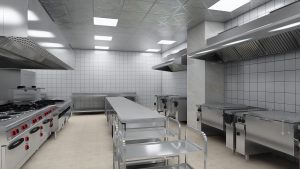
3. Human Resource Management and Training
High productivity is impossible without an efficient and trained team. Staff must be fully familiar with processes, equipment, and hygiene standards.
- Continuous staff training: Practical and theoretical training in equipment operation, hygiene, and time management is essential.
- Optimal task allocation: Matching staff skills to tasks increases speed and reduces errors.
- Motivation and positive work environment: Encouraging collaboration and reducing fatigue directly impacts productivity.
Human resources, as the most critical production factor, play a key role in improving productivity and reducing waste.
4. Optimization of Raw Materials and Inventory Management
Proper management of raw materials, storage, and inventory reduces waste and increases productivity.
- Digital inventory management systems: Accurate control of raw materials, expiration dates, and stock prevents production halts or overproduction.
- Order and delivery scheduling: Timely procurement reduces storage costs and prevents material spoilage.
- Waste reduction: Analyzing consumption and production data identifies waste points and improves processes.
Intelligent management of raw materials significantly boosts overall kitchen productivity while lowering costs.
5. Workspace Design and Ergonomics
Proper layout and ergonomic design allow staff to achieve maximum output with minimal movement and energy.
- Logical arrangement of tools and equipment: Tools and consumables should be easily accessible to minimize unnecessary movement.
- Standard and adjustable workstations: Correct table heights, easy access to equipment, and sufficient lighting reduce fatigue and increase speed.
- Safe, obstacle-free pathways: Preventing collisions and ensuring safety reduces accidents and operational interruptions.
Optimized workspace design enhances productivity and ensures staff health.
6. Use of Smart and Digital Technologies
Today, smart industrial kitchens use data and technology to make processes faster, more accurate, and more efficient.
- Production and quality control systems: Real-time monitoring of temperature, cooking time, consumption, and product quality.
- Automation and robotics: Automated cutting, mixing, and packaging equipment improves speed and precision.
- Data analysis and performance optimization: Analyzing production data helps identify patterns and improve operational decisions.
Smart technology transforms kitchens from traditional environments into efficient, modern production centers.
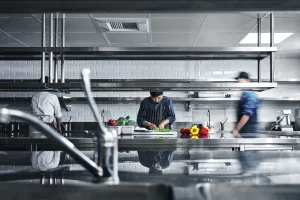
7. Continuous Improvement and Performance Monitoring
Productivity is not a one-time process; it requires ongoing monitoring and continuous improvement.
- Key Performance Indicators (KPIs): Define metrics such as food preparation time, waste levels, service speed, and product quality.
- Continuous staff feedback: Employees can identify operational issues and suggest improvements.
- Periodic process review: Analyzing data, refining workflow, equipment, and methods ensures continuous productivity growth.
A continuous improvement cycle guarantees that the industrial kitchen consistently operates at peak efficiency.
Conclusion
Increasing productivity in industrial kitchens is the result of a combination of process optimization, intelligent resource management, technology utilization, and staff training.
Benefits of implementing these strategies include:
- Reduced costs and raw material waste
- Improved quality and production consistency
- Reduced preparation and delivery time
- Enhanced working conditions and employee satisfaction
- Continuous development and operational improvement
By applying these principles, any industrial kitchen can become a modern, efficient, and smart production environment that not only increases productivity but also complies with global safety and quality standards.